At the far end of Duxbury Beach, past the guard gate where the pavement gives out, sit three small villages that most Duxbury house hunters will never see on a listing sheet. Saquish Head holds about 52 homes. Saquish Neck holds around 120. The Gurnet, closest to the lighthouse, has roughly 55. Add them up and you get 227 houses sitting on some of the most exposed, most photographed shoreline on the South Shore, and by local account, almost none of them change hands through a normal sale. They get passed down.
That single fact should reshape how a buyer thinks about "Duxbury waterfront" as a category. The mainland market, the one showing up in home value estimates and active listings, runs on the usual mechanics: appraisals, comps, financing, turnover. The outer peninsula runs on family succession, unpaved road access, and a jurisdictional split that puts the land in a different town than the one controlling how you drive to it. Anyone comparing Duxbury to Scituate or Cohasset on price alone is missing an entire slice of the town's coastline that barely participates in the market being measured.
Three Villages, One Road, Two Towns
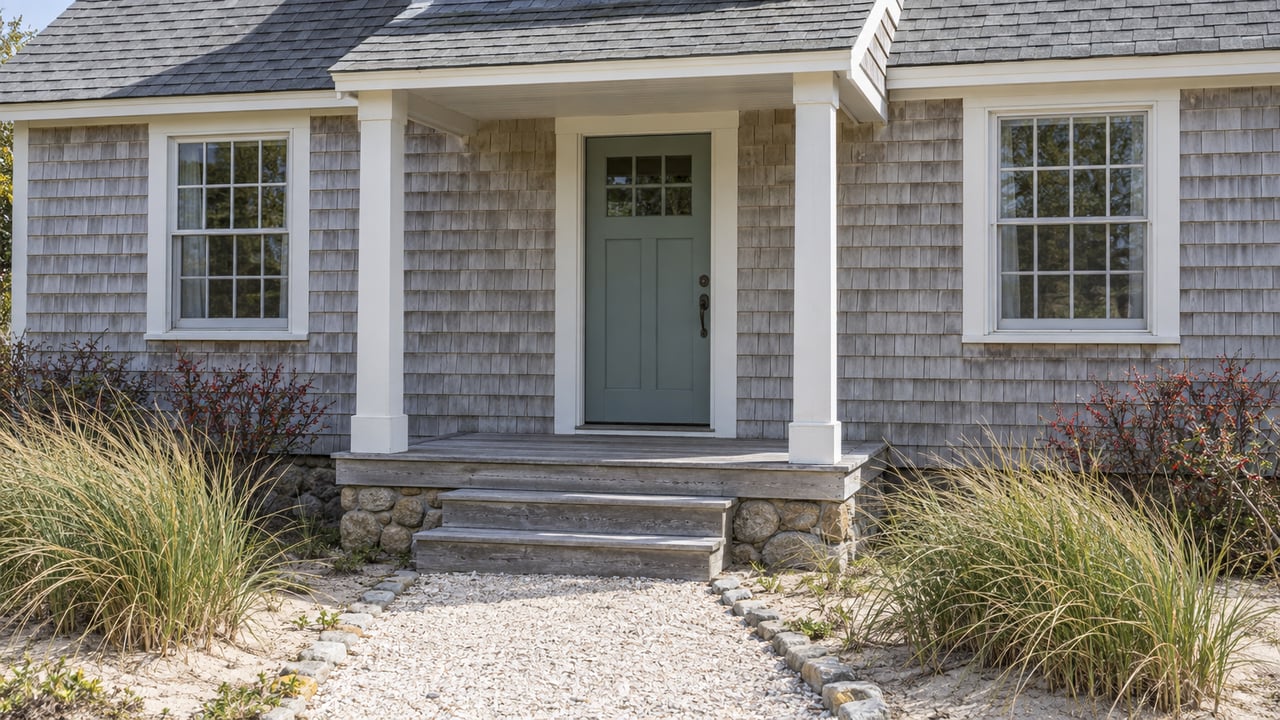
Saquish Head, Saquish Neck, and The Gurnet sit on a barrier spit that connects to Duxbury at the Powder Point Bridge and runs south past the Duxbury Beach Reservation toward the tip of Plymouth Bay. Fifty cottages went up on Saquish during the 1950s, after the arrival of the Jeep made the peninsula practical to reach, and the settlement pattern that followed still shapes the place today. There are no paved roads out there. There are no public utilities. Homeowners run generators, propane tanks, solar collectors, and rain barrels, and the road itself is described locally as alternating between sand traps and deep ruts, when it isn't simply the beach.
Here is the detail that surprises people who assume the whole peninsula is Duxbury: it isn't. Saquish and The Gurnet are administratively part of Plymouth, even though the only way to reach them by land is through Duxbury.
| Village | Approximate homes | Governing town |
|---|---|---|
| Saquish Head | 52 | Plymouth |
| Saquish Neck | 120 | Plymouth |
| The Gurnet | 55 | Plymouth |
That split shows up in something as mundane as a property address. Two vacant parcels sold recently on the peninsula, one at $22,000 with a Duxbury mailing address and zip code 02332, the other at $25,000, a 0.57-acre lot, addressed in Plymouth's 02360. Neither had a structure on it. Both sat within a mile or two of each other on the same barrier beach. The addressing itself refuses to agree on which town this land belongs to, and that ambiguity follows the property all the way through a transaction.
Land That Doesn't Behave Like a Normal Lot
Most of what gets called Duxbury waterfront trades the way waterfront trades anywhere: a listing goes up, buyers tour it, an offer gets accepted. The outer peninsula doesn't work that way. Homes there are generally kept within families rather than sold on the open market, which means the ordinary signals a buyer relies on, comparable sales, days on market, price trends, barely exist for this pocket of town. When a parcel does come up, it isn't always a house. Sometimes it's raw, unbuildable-feeling land selling for the price of a used car, the way those two Saquish and Gurnet lots did.
When cottages there do reach a buyer, the range has run from the low $300,000s for older, smaller places up past $800,000 for larger, newer construction. That's a wide band for a community with no more than roughly 227 total houses, and it reflects how little standardized data exists to narrow it. A buyer pricing a Saquish cottage isn't working off twenty recent comps. They're working off whatever handful of sales happened to leak out in a given decade.
The Permit That Decides Who Drives In
Here's the part that catches people off guard even after they understand the land is technically Plymouth. The only road onto the peninsula is controlled by Duxbury, not Plymouth, and it isn't open to the public. The Town of Duxbury's own beach operations page states plainly that access to the oversand vehicle beach and backroad requires a year-round town permit, that there is no public access, and that violations carry fines up to $500 with towing.
Duxbury also limits who qualifies for the standard resident sticker. According to the town's own permit rules, resident beach and transfer station stickers go only to vehicles registered to a Duxbury property owner or taxpayer, excluding land-only property, or to a qualifying renter. Since homes on Saquish and The Gurnet sit administratively in Plymouth, their owners are paying property taxes to a different town than the one that controls their driveway. Anyone buying out there should confirm directly with Duxbury's Treasurer's office which permit category actually applies to their specific parcel, because the standard resident pricing that a mainland Duxbury buyer takes for granted may not be the deal a peninsula buyer gets.
That's a piece of transaction friction that never shows up on a deed, a Zillow estimate, or a walk-through. It only shows up when someone tries to drive home.
What the Rest of Duxbury Is Doing While This Pocket Sits Still
The contrast matters because the mainland market keeps moving in ways the peninsula simply doesn't register. As of late July 2026, estimates put the average home value across Duxbury at roughly $1.13 million, up about 5 percent from a year earlier. As of early September 2026, the several dozen homes actively listed in town were averaging close to $1.6 million. When Duxbury's Selectboard held its fall tax classification hearing setting the rate for fiscal year 2026, assessors reported that town-wide property values had grown by $326 million over the prior year, pushing total assessed value to roughly $7.3 billion. The rate the town has posted for the current fiscal year sits at $9.96 per $1,000 of assessed value.
Every one of those figures is built on a market that turns over: sales, refinances, reassessments, new construction. The outer peninsula barely feeds into any of it. A cottage that's been in the same family since the 1950s doesn't get reappraised the way a mainland sale does, doesn't generate a comp, and doesn't nudge the town's median in either direction. Two markets sit inside the same town boundary, one driving the numbers everyone quotes and one that mostly sits outside them.
A Few Questions Worth Asking Before You Look
Do Saquish and Gurnet cottages ever actually reach the MLS? Occasionally, but rarely, and usually because a family is settling an estate rather than choosing to sell. Anyone interested in that pocket of the market should expect a longer wait and a smaller pool of comparable sales than a typical Duxbury search.
Can you get a standard mortgage on one of these properties? It depends heavily on the individual lender and the specific parcel's road access, utility setup, and how the property is described in title records. Buyers considering a cottage here should expect a more involved underwriting conversation than a typical mainland Duxbury purchase, and should raise the financing question with a lender early, before writing an offer.
Who actually collects property taxes on these homes? Plymouth, not Duxbury, despite the fact that Duxbury Beach Reservation and the Town of Duxbury control the road that gets you there. It's worth confirming with both towns directly which one is billing a specific parcel before assuming either set of rates applies.
If you're weighing a Duxbury property against everything else on the South Shore, including the rare listing that surfaces on Saquish or The Gurnet, Tara Coveney can walk you through what a specific parcel's access, utilities, and tax jurisdiction actually mean before you write an offer. Request a private market consultation to get the full picture on any Duxbury property you're considering.